
Pets and consumer apps
A soccer practice plan for grassroots teams, with U8 and U10 timings
A 60 minute soccer practice plan for grassroots coaches: warm up, skill block, small sided game and scrimmage, with an age table for U6 to U12.
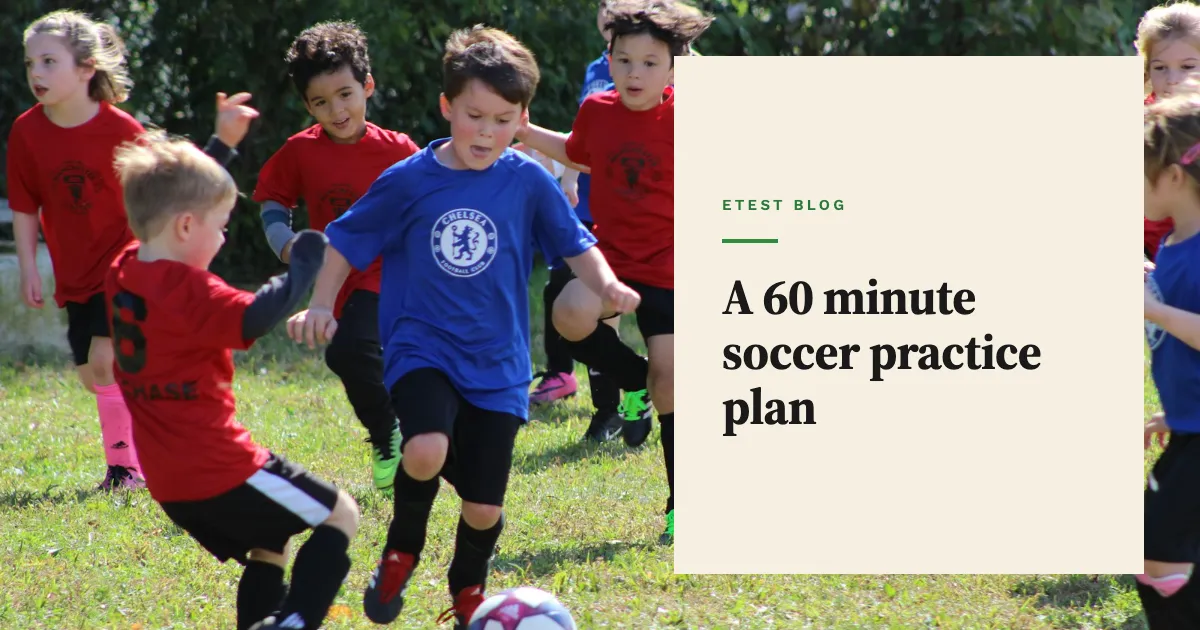
A good soccer practice plan for a grassroots team fits in 60 minutes: a 10 minute warm up with a ball each, a 15 minute skill block on one topic, a 15 minute small sided game that rewards that skill, and a 13 minute scrimmage, with two water breaks and a quick close. Keep every child touching the ball.
Below is that plan block by block, then how to adjust it for U6, U8, U10 and U12 using US Soccer's own age guides.
Key points
- One topic per session. Dribbling, or passing, or shooting. Not all three.
- Every block is a game or looks like one. No lines, no laps, no lectures.
- US Soccer recommends Play, Practice, Play: start with a game, practise, finish with a game.
- Match your small sided games and scrimmage to the format your age group actually plays.
- Draw each block once and send it to your assistants before the session.
What does a 60 minute soccer practice plan look like?
It has four working blocks. A warm up with a ball for every player, a technical block that teaches one skill, a small sided game where that skill wins points, and a scrimmage in your match format. Two short water breaks and a two minute close bring it to an hour.
| Time | Block | What happens | Coaching focus |
|---|---|---|---|
| 0 to 10 min | Warm up with the ball | Everyone dribbles in a grid; a tag game where you keep the ball while dodging | Lots of touches, both feet |
| 10 to 25 min | Technical block | The topic in pairs or small groups, such as 1v1 to two small gates | One coaching point, said once |
| 25 to 28 min | Water | Drinks, groups set for the next game | Quick and quiet |
| 28 to 43 min | Small sided game | 3v3 or 4v4 with a rule that rewards the topic, like a bonus goal for dribbling over the end line | Praise the skill when it happens |
| 43 to 45 min | Water | Drinks, bibs on for the scrimmage | |
| 45 to 58 min | Scrimmage | Your match format, few stops | Let them play |
| 58 to 60 min | Close | One question, one piece of praise | End on a high |
The timings are mine, not an official figure. US Soccer's Play, Practice, Play article describes the three stages but gives no minutes for them. My plan maps onto it: the warm up and small sided game are the play, the technical block is the practice, and the scrimmage is the final uninterrupted game.
How should the plan change for U6, U8, U10 and U12?
Change the size of the games more than the shape of the session. US Soccer's age guides list small sided games from 1v1 and 2v2 at U6 up to 9v9 at U12, and maximum match formats of 4v4 at U7 to U8, 7v7 at U9 to U10 and 9v9 at U11 to U12. Younger players also need shorter blocks.
| Age | Small sided games, US Soccer | Maximum match format | Heading | Skill ideas from the guides | Session length I'd use |
|---|---|---|---|---|---|
| U6 | 1v1, 2v1, 2v2 | None listed | None | Dribbling, running with the ball, receiving, shooting | 30 to 45 min |
| U8 | 1v1 up to 4v4 | 4v4 | None | Both feet, shooting from 5 to 10 yards, short passing | 45 to 60 min |
| U10 | 1v1 up to 7v7 | 7v7 | None | Passing, crossing and shooting up to 20 yards; covering and marking | 60 min |
| U12 | 1v1 up to 9v9 | 9v9 | Up to 30 min of heading practice a week, 15 to 20 headers per player a week | Formations for 9v9, all positions | 60 to 75 min |
The small sided games, formats and heading rules come from US Soccer's age group guides and its game formats page, read on 4 November 2026. US Soccer says smaller formats can be played at every age, and that U11 players should not head the ball at all. The last column is my own rule of thumb. If you coach in England, formats differ; I compare them in tactics board apps for 7v7 and 9v9.
For U6, I'd drop the technical block almost entirely and run three short games with water in between. They learn by playing at that age, and US Soccer's U6 guide says to use regular short breaks and keep instructions short.
How do I keep kids moving the whole session?
Give every player a ball for the warm up, keep groups to four or fewer per activity, and set up every area before anyone arrives. Talk for well under a minute at a time. US Soccer's Play, Practice, Play article contrasts its model with children standing in lines, running laps and doing drills that don't look like soccer.
What tends to work:
- Set up early. Lay out every grid and gate before the first child arrives, so you can go from one block to the next in seconds.
- Arrival game. Start a 2v2 the moment two players turn up. Latecomers join in. Nobody waits.
- One coaching point. Say it, show it once, play. If they don't get it, freeze the game briefly and show it again.
- No queue longer than two. If an activity needs a line, split it into two or three copies.
- Water as transitions. Use the breaks to reset bibs and groups so the next block starts straight away.
My opinion, for what it's worth: the scrimmage is the block most coaches cut when they run late, and it's the one kids enjoy most. Cut the technical block shorter instead.
How do I share the plan with assistant coaches?
Send it the night before as one picture per block, each with the time, the area size, the groups and the single coaching point. Give each assistant one block to own. On the day, a quick look at the phone is enough, and the session runs even if you're stuck talking to a parent.
A few habits that help:
- Name each block. "Gates", "Bonus goal", "Scrimmage". Short names travel well on a noisy field.
- One assistant, one area. They set it up, run it and reset it.
- Same plan, two weeks. Repeating a session lets assistants get comfortable and lets kids improve at it.
- Write the point, not the drill. "Head up before the gate" is more useful than a paragraph.
How can a tactics board app help draw drills?
A tactics board app lets you draw each block once, with players, arrows and areas, and send it as an image. I built Tactics Board 3D: Soccer Coach for this kind of planning. It has pitch shapes for 5, 7, 9 and 11 a side, pass and run arrows, shaded zones and steps you play back.
For a practice plan, here's how to use it:
- Pick the pitch size. A 7 a side pitch for a U10 scrimmage, so the spacing on the picture matches the field.
- Mark areas with shaded zones. A shaded zone stands in for a grid or a gate. The app has no cones or equipment library, so if you want those in your diagrams, an app with drill equipment suits you better.
- Draw the movement. Solid arrows for passes, dashed arrows for runs, the freehand pen for anything else.
- Use steps. Show the 1v1 in two or three steps, then press Play to watch players and the ball move.
- Share each step as an image to the team chat, and keep your plays saved on your phone, filtered by pitch size.
It needs no account. It's on the App Store and Google Play. Draw this session in Tactics Board 3D on iPhone or Android. For match planning, I've also written about planning set pieces on a tactics board app and 4-3-3 vs 4-4-2 for grassroots coaches.
Frequently asked questions
How long should a U8 soccer practice be?
US Soccer's age guides I read don't set a length. I'd plan 45 to 60 minutes for U8, with short blocks, two water breaks and games up to 4v4, which is US Soccer's maximum match format for U7 and U8. Stop while they still want more.
What should a U10 soccer practice plan include?
A warm up with a ball each, one technical topic such as passing or 1v1 defending, a small sided game that rewards it, and a 7v7 scrimmage, which is US Soccer's maximum format for U9 and U10. US Soccer's U10 guide also says to introduce warm ups and covering and marking.
Should young players practise heading?
Not under US Soccer's guidance until U12. Its age guides say no heading in practice or games through U11. At U12, it allows no more than 30 minutes of heading practice a week and 15 to 20 headers per player per week.
What is Play, Practice, Play?
It's US Soccer's recommended structure for grassroots sessions. Players start with a game they lead, the coach then runs practice activities that look like the game, and the session ends with an uninterrupted game where players show what they learned. The coach guides with minimal talking.
How many players should be in each drill?
As few as the activity allows. US Soccer's guides build up from 1v1 and 2v2, and groups of two to four keep every child busy. If you have 12 players and one activity, make three copies of it rather than one long line.
How I wrote this
On 4 November 2026 I read US Soccer's Play, Practice, Play article, its age group guides for U6, U7 to U8, U9 to U10 and U11 to U12, and its game formats page. None of them sets a session length, so the 60 minute template and the timings are my own coaching advice. I checked search volumes in Google Keyword Planner for the United States. The app details come from Tactics Board 3D, which I built, and its store listings.
By John Osakwe, founder of Etest Tech Hub. I have built apps and websites since 2015, including Etest CBT, FizzFree and Pawlarm.
See the apps I published
Etest CBT, FizzFree and Pawlarm are my own apps. Each has a page with what I built and how.

John Osakwe
John Osakwe has built 100+ apps and websites since 2015, including Etest CBT, FizzFree and Pawlarm. More about John.