
Pets and consumer apps
4-3-3 vs 4-4-2 for grassroots coaches, shown on a tactics board
4-3-3 vs 4-4-2 for grassroots teams: what each shape asks of players, when to pick which, and how to show both to your squad on a tactics board app.
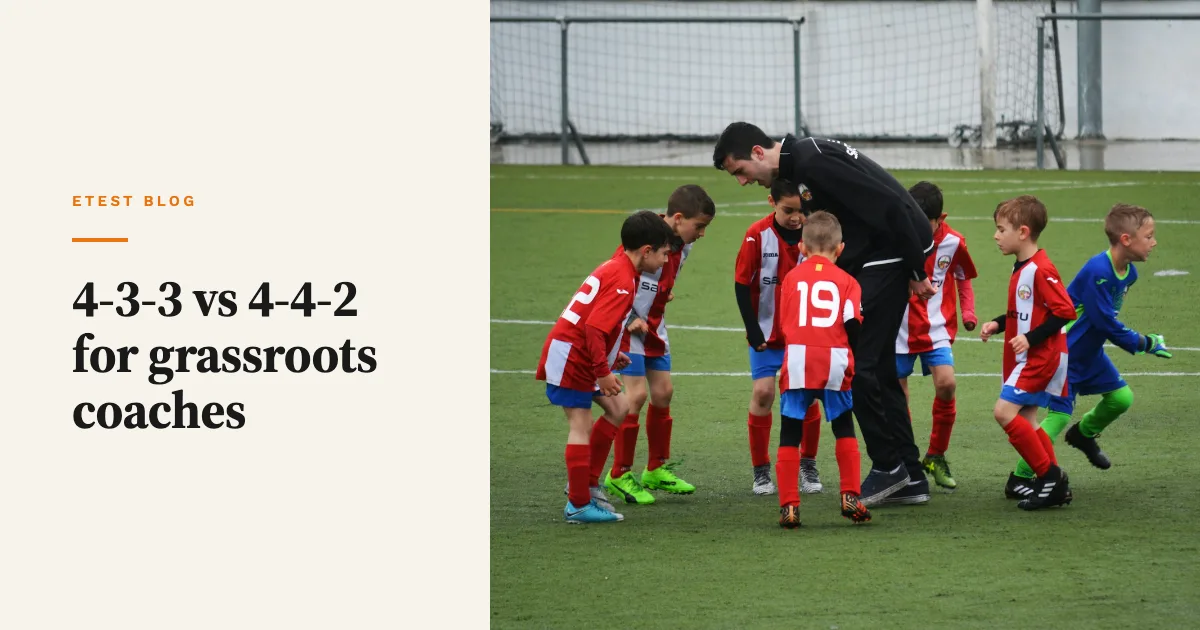
The 4-3-3 vs 4-4-2 choice for a grassroots team comes down to your midfield: 4-4-2 gives players simple pairs and two clear banks to defend in, while 4-3-3 gives you width up front and passing triangles but asks one central midfielder to read the game. For most young or new teams, I would start with 4-4-2.
Key points
- 4-4-2 is easier to teach: two banks of four, a partner for everyone, and two strikers to aim at.
- 4-3-3 suits teams with a calm central midfielder and wingers who will track back.
- The weak spot of 4-4-2 is the space between the lines. The weak spot of 4-3-3 is the space either side of the lone holding midfielder.
- Show your squad four pictures for either shape: the shape, pressing, building up and the danger zone.
- I draw these in my own app, Tactics Board 3D: Soccer Coach, on the App Store and Google Play. Any tactics board app will do.
What is the difference between 4-3-3 and 4-4-2?
Both start with a back four. The difference is the six players in front.
- 4-4-2: four midfielders in a flat line, two of them wide, and two strikers.
- 4-3-3: three central midfielders, usually one sitting deeper, and three forwards: a striker and two wingers.
So 4-4-2 has more players in wide midfield and a strike partnership. 4-3-3 has an extra body in central midfield and its width comes from higher up the pitch. That one shift changes almost every job on the team.
Why is 4-4-2 easier for grassroots players?
Because every player has a partner and a line to hold.
- Pairs. Two centre backs, two central midfielders, two strikers. Each player can look sideways and see who they work with.
- Two banks of four. Out of possession, the defence and midfield form two lines. Telling a 12 year old "stay in your line" is easier than explaining when to step into a pressing trap.
- Simple outlets. When in doubt, find a wide midfielder or play up to the front two. Young players need easy answers when under pressure.
- Strikers help each other. One goes short, one goes long. You can coach that in one session.
The cost: in a flat four, the gap between midfield and defence opens up if the midfield pushes too high. A clever opposition number ten will live there.
When is 4-3-3 the better choice?
When you have the players for it. Specifically:
- A calm holding midfielder. The deeper of the three must stay put, screen the centre backs and take the ball under pressure. If nobody in your squad does that naturally, 4-3-3 will hurt you.
- Wingers who work both ways. Without the ball, the wingers must drop back to help the full backs, or the full backs face two attackers alone.
- A passing team. Three central midfielders create triangles all over the pitch. If your team likes to keep the ball, 4-3-3 gives them more options.
The cost: the spaces either side of the holding midfielder. If the two other midfielders push forward together, the opponent can play straight through the middle.
My honest view: grassroots coaches pick 4-3-3 because the professional teams they watch use it, then spend the season fixing the holes it leaves. Start with the shape your players can understand on a wet Saturday, and earn the more complex one.
What four pictures should I show my players?
Whichever shape you pick, a squad needs to see four things. I draw each one as a separate step so the players see one idea at a time.
- The shape. All eleven in position, with names on the players. Nothing else on the board.
- Out of possession. Shade the zone you want to defend in. For 4-4-2, draw the two banks of four tight together. For 4-3-3, draw the wingers dropping back and the holding midfielder staying central.
- Building up. Arrows from the goalkeeper and centre backs to the first pass. In 4-4-2, the wide midfielders and the near striker. In 4-3-3, the holding midfielder and the full backs.
- The danger zone. Put an opponent in the space your shape leaves open. For 4-4-2, between the lines. For 4-3-3, beside the holding midfielder. Then draw who covers it.
Press Play to run the steps in order. Then send them to the team chat the night before training, so players arrive having seen it once.
How do I set this up in Tactics Board 3D?
I built Tactics Board 3D: Soccer Coach, and this is how I do it there.
- Pick 11 a side and choose 4-4-2 for your team. Choose a formation for the opponent too, say 4-3-3, so the board shows the real matchup.
- Name your players. Drag anyone whose role differs from the default.
- Draw passes with solid arrows, runs with dashed arrows, and shade the zone to defend.
- Add a step for each of the four pictures, then press Play to see players and the ball move.
- Share a step as an image to the team chat.
For small sided football, the app has its own shapes. On 9 a side there is 3-3-2, on 7 a side 2-3-1, and on 5 a side 2-2. The same ideas apply: pairs and lines, or triangles and width.
It runs on iPhone, iPad and Android. See Tactics Board 3D, or read my longer review as the maker.
Frequently asked questions
Is 4-4-2 or 4-3-3 better for youth football?
Neither is better in every case. For young or new players I would start with 4-4-2, because pairs and two banks of four are easy to understand. Move to 4-3-3 when you have a holding midfielder who stays calm on the ball and wingers who track back.
What is the weakness of 4-4-2?
The space between the midfield line and the defence. If the midfield four step up and the back four stay deep, an opposition attacker can receive the ball between them and turn. Coach the two lines to move up and back together, as if tied with a rope.
What is the weakness of 4-3-3?
The spaces either side of the single holding midfielder, and the full backs being exposed when the wingers do not track back. If both advanced midfielders push on at once, the opponent can play through the middle. One of them must always stay near the holding player.
Can I switch between 4-4-2 and 4-3-3 in a game?
Yes, and it is a useful skill. Many teams defend in a 4-4-2 shape, with a winger dropping into midfield and a midfielder stepping up beside the striker, then attack in 4-3-3. Teach it only once your players know one shape well, or the switch causes confusion.
How I wrote this
The coaching views here are my own, formed while building a tactics board app and drawing these shapes in it. They are opinion, not rules from a governing body or findings from a study. The formations and features I describe come from Tactics Board 3D, which I built, and its listings on the App Store and Google Play, read on 24 October 2026.
By John Osakwe, founder of Etest Tech Hub. I have built apps and websites since 2015, including Etest CBT, FizzFree and Pawlarm.
See the apps I published
Etest CBT, FizzFree and Pawlarm are my own apps. Each has a page with what I built and how.

John Osakwe
John Osakwe has built 100+ apps and websites since 2015, including Etest CBT, FizzFree and Pawlarm. More about John.