
Quit soda and habit health
If I stop drinking soda, will I lose weight? An honest calculator
Will you lose weight if you stop drinking soda? A worked method using the NIH body weight model, a table for 1 to 3 drinks a day, and the 3,500 myth.
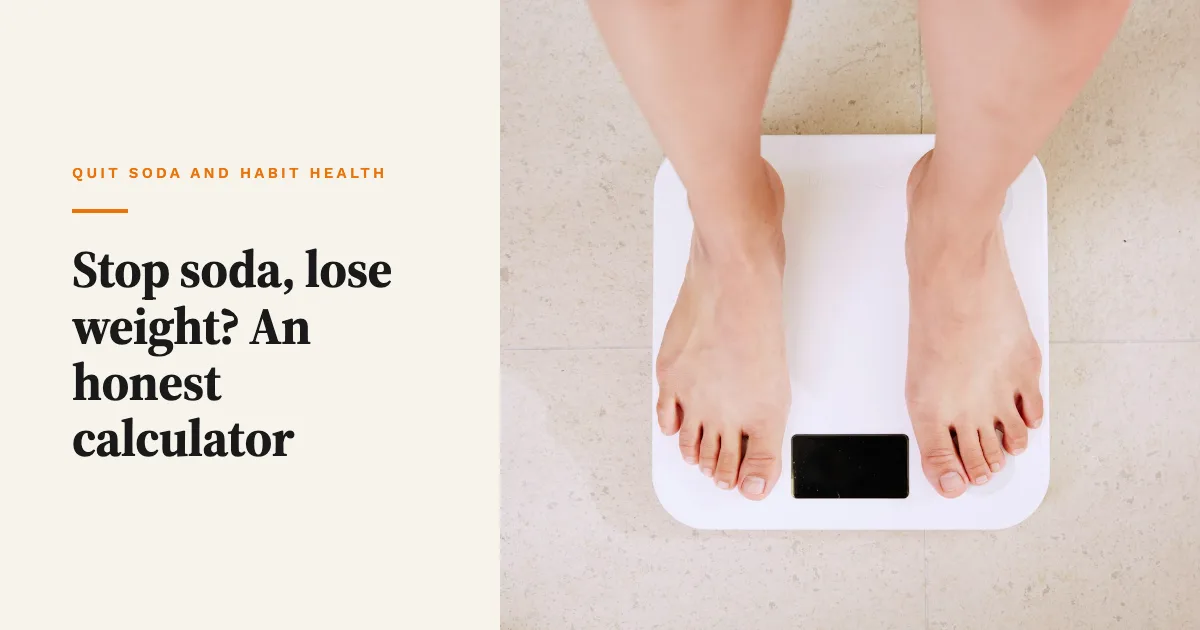
If I stop drinking soda, will I lose weight? Often, yes, but less than the old 3,500 calorie rule promises. By the NIH body weight model, cutting one 138 calorie can a day, with nothing else changing, means about 2.9 kg lost in year one and 5.8 kg in total, not 6.5 kg every year.
Key points
- The old rule says 3,500 calories equals one pound of fat, so the loss should keep going in a straight line. It does not. Your body burns less as it gets smaller.
- The NIH model behind the Body Weight Planner gives a simple rule of thumb: every 10 calories a day you cut leads to about one pound lost in the end, with half of it in the first year.
- One 50cl bottle of regular cola a day is about 195 calories. Cutting it points to roughly 4 kg in year one and about 8 kg in total.
- This only holds if you do not replace the soda with something else that has calories, like juice, malt or extra snacks.
- You cannot pick where the fat comes from, so "belly fat" is not a separate result.
- This is general information, not medical or veterinary advice. If you have diabetes or a history of an eating disorder, talk to your doctor before you change what you eat or drink.
I built a soda tracker, and the first thing people ask me after "how much money will I save" is "how much weight will I lose". I wanted an honest answer, so I went to the research instead of the TikTok stories.
How do I work out the calories I will stop drinking?
Take the drinks you have each day, multiply by the calories in one drink, then multiply by 365. That is the yearly total you stop drinking. The number on your label is what counts, because recipes and sizes differ between countries.
Here is the method on paper:
- Calories per drink. Look at the label. It usually gives kcal per 100 ml. Multiply by the size in ml and divide by 100. A US Coke label lists 39 kcal per 100 ml, so a 50cl bottle is 39 × 500 ÷ 100 = 195 kcal.
- Calories per day. Multiply by how many you drink. Two 50cl bottles is 390 kcal.
- Calories per year. Multiply by 365. Two bottles a day is 142,350 kcal.
For reference, the USDA label records list 138 calories for a 12 oz can of Coca-Cola and 155 for a 12 oz can of Pepsi. A 33cl can of cola at 39 kcal per 100 ml comes to about 129, and a 35cl bottle about 137. Check your own bottle, though. I live in Lagos, and the labels here are not always the same as the US ones.
Why is the 3,500 calorie rule wrong?
The 3,500 rule takes your yearly calories, divides by 3,500 and calls that pounds lost, every year, forever. The problem is that a lighter body burns fewer calories, so the gap you created shrinks as you lose weight. Weight loss slows down and then levels off.
Kevin Hall and colleagues at the NIH's National Institute of Diabetes and Digestive and Kidney Diseases built a model that accounts for this, and published it in The Lancet in 2011. They wrote that the 3,500 rule "ignores dynamic physiological adaptations". A 2013 paper by Diana Thomas and others in the International Journal of Obesity compared the rule with seven supervised weight loss experiments and found it grossly overestimates actual weight loss.
Honestly, the old rule is not useless. It gets the direction right. It just gets the size and the timing wrong, and it never stops.
What does the NIH model say about quitting soda?
The Hall paper gives a rule of thumb for an average overweight adult: every 10 calories a day you cut leads to about one pound lost in the end. Metric version: every 100 kJ a day, which is about 24 kcal, leads to about 1 kg. You reach about half of that in the first year and about 95% by year three.
So the realistic method has two more steps:
- Eventual loss. Calories per day × 4.184 ÷ 100 gives kilograms. Or calories per day ÷ 10 gives pounds.
- Timing. Halve it for year one. Take 95% of it for year three.
Worked example, one 50cl regular cola a day:
- 195 kcal × 4.184 ÷ 100 = about 8.2 kg in the end.
- About 4.1 kg in the first year.
- About 7.8 kg by the end of year three.
The old rule would say 195 × 365 ÷ 7,700 = 9.2 kg in the first year, then another 9.2 kg the next year, and so on. That second year is where it goes badly wrong.
How much weight could I lose? The table
These figures assume an average overweight adult who changes nothing else. The calories come from the US Coke label at 39 kcal per 100 ml. Swap in your own label if it differs.
| What you stop drinking | Kcal a day | Kcal a year | Old 3,500 rule, year one | NIH rule of thumb, year one | NIH rule of thumb, in the end |
|---|---|---|---|---|---|
| One 33cl can a day | 129 | 47,085 | 6.1 kg | 2.7 kg | 5.4 kg |
| One 50cl bottle a day | 195 | 71,175 | 9.2 kg | 4.1 kg | 8.2 kg |
| Two 50cl bottles a day | 390 | 142,350 | 18.5 kg | 8.2 kg | 16.3 kg |
| Three 50cl bottles a day | 585 | 213,525 | 27.7 kg | 12.2 kg | 24.5 kg |
A few things the table can't know about you. The Hall paper found that people with more body fat lose more for the same change, and take longer to get there. If you are lean, expect less. And the NIH tool itself notes that people often underestimate how much they eat, so a habit you think is two bottles might be three, or one.
If you want a figure for your own height, weight, age and activity, put your numbers into the NIH Body Weight Planner. It runs the full model. I used the rule of thumb here so you can check every number with a phone calculator.
Will quitting soda get rid of belly fat?
Not on its own, and not just there. You cannot choose where your body takes fat from. In a 2011 study by Vispute and colleagues, sedentary adults did abdominal exercises five days a week for six weeks and had no significant change in belly fat or waist size. If quitting soda lowers your total body fat, your waist shares in that, along with everywhere else.
"If I stop drinking soda will I lose belly fat" is a fair question. The honest answer is that the belly follows the total.
What if I switch to diet soda instead?
Diet soda labels show almost no calories, so on paper it gives you the same numbers as quitting. In practice the evidence is weaker. In May 2023 the World Health Organization advised against using non-sugar sweeteners to control body weight, saying they do not give a long-term benefit in reducing body fat in adults or children. It is a conditional recommendation, and it does not cover people with diabetes.
My take: switching to diet soda is a reasonable step down if quitting outright feels impossible, but don't count it as a weight loss plan.
How do I make the change actually stick?
The maths only works if the calories stay gone. A common trap is drifting into juice, malt, sweet tea or a second snack, which quietly eats the gap. Pick a swap with no calories, like cold water with lime or plain sparkling water, and decide what you will drink before the 3 pm craving shows up.
Tracking helps, because a streak and a running total are hard to ignore. In FizzFree, the tracker I built, you can quit at once or use reduce mode, and it shows the sugar, caffeine and calories you skipped along with your savings. It has no account, the tracker is free with ads, and Premium is optional.
If you want the sugar side of this, I wrote about how much sugar is in a can of soda. And if you are choosing a tracker, here are quit soda apps compared.
Frequently asked questions
How much weight will I lose if I stop drinking one soda a day?
For an average overweight adult, cutting one 138 calorie can a day points to about 2.9 kg in the first year and about 5.8 kg in total, using the rule of thumb from the NIH model by Hall and colleagues. Your result depends on your size, and on not replacing the calories.
Is 3,500 calories really one pound of fat?
As a one off energy count it is close, but as a forecast it fails. It ignores the fact that your body burns less as you get lighter. A 2013 study compared it with seven supervised experiments and found it grossly overestimates weight loss over time.
How long does it take to see weight loss after quitting soda?
The change is slow. In the NIH model, about half of the total loss comes in the first year and about 95% by year three. So judge it over months, not days.
Will I lose weight if I stop drinking diet soda?
Probably not much from the calories, since diet soda labels show almost none. The WHO advised in 2023 against relying on non-sugar sweeteners for weight control, but that does not mean stopping them causes weight loss. Any change would come from what you eat and drink instead.
Can I use the NIH Body Weight Planner for this?
Yes. Enter your details and a change in daily calories equal to the soda you are dropping. It is for adults 18 and over, and not for pregnant or breastfeeding women. The NIH says it is not medical advice.
How I wrote this
On 24 October 2026 I read the Hall 2011 Lancet paper in full on PubMed Central, the Thomas 2013 and Vispute 2011 abstracts on PubMed, the WHO sweetener guideline release, the NIH Body Weight Planner page and the USDA label records for Coca-Cola and Pepsi. Every weight figure uses the published rule of thumb and my own arithmetic, which I checked twice. I did not run the full Body Weight Planner for a sample person, so the table is an estimate for an average overweight adult, not a personal forecast.
This is general information, not medical or veterinary advice. Ask your doctor or vet.
By John Osakwe, founder of Etest Tech Hub. I have built apps and websites since 2015, including Etest CBT, FizzFree and Pawlarm.
Track your streak with FizzFree
A quit soda tracker with streaks, money saved and a Craving SOS. No account needed.

John Osakwe
John Osakwe has built 100+ apps and websites since 2015, including Etest CBT, FizzFree and Pawlarm. More about John.