
Post-UTME past questions and screening
Learn how university screening works after JAMB, try real Post-UTME questions with worked answers, and practise screening papers in a timed CBT on your phone with Etest CBT.
How Post-UTME screening works
After UTME results come out, each university screens the candidates who chose it. To be screened you normally need to have picked that school, to have scored at least its cut-off mark in the UTME, and to have the O'level credits your course asks for.
Each university sets its own cut-off, and it can never be below the minimum JAMB sets for universities. Popular schools and courses ask for much more. For example, the University of Lagos limited its 2025/2026 screening to candidates who chose it first and scored 200 or more.
Test or document screening
Some universities set a Post-UTME test, often a computer based test across your UTME subjects plus general questions. Others screen on documents only, ranking you on your UTME score and O'level grades.
The final ranking is an aggregate of your UTME score, the Post-UTME result and, at some schools, your O'level grades. The formula differs from school to school, so read your university's screening notice. You can work out the JAMB part with the aggregate calculator below.
Try five Post-UTME questions
These come from past university Post-UTME papers. Pick an answer to see the explanation.
Question 1. Plants that are adapted to survive drought are called
Show the answer
D: xerophytes. Xerophytes, such as cacti, cut water loss with thick cuticles, sunken stomata and small or spiny leaves.
Question 2. A bag holds 10 balls: 3 red and 7 white. Two balls are drawn with replacement. What is the probability that neither is red?
Show the answer
D: 0.49. With replacement the draws are independent. P(white) = 7/10 each time, so P(neither red) = 0.7 × 0.7 = 0.49.
Question 3. A body accelerates uniformly from rest at 6 m/s² for 8 s, then slows uniformly to rest in the next 5 s. What is the size of the deceleration?
Show the answer
A: 9.6 m/s². Top speed = 6 × 8 = 48 m/s. It loses 48 m/s in 5 s, so the deceleration is 48 ÷ 5 = 9.6 m/s².
Question 4. A deficit budget is usually drawn up during
Show the answer
D: an economic recession. In a recession the government spends more than it collects to raise demand and create jobs. In a boom or inflation it would aim for a surplus.
Question 5. A brief, witty saying is called
Show the answer
B: an epigram. An epigram is a short, clever statement, often with a twist. An anecdote is a short story about a real event.
Practise Post-UTME questions in Etest CBT
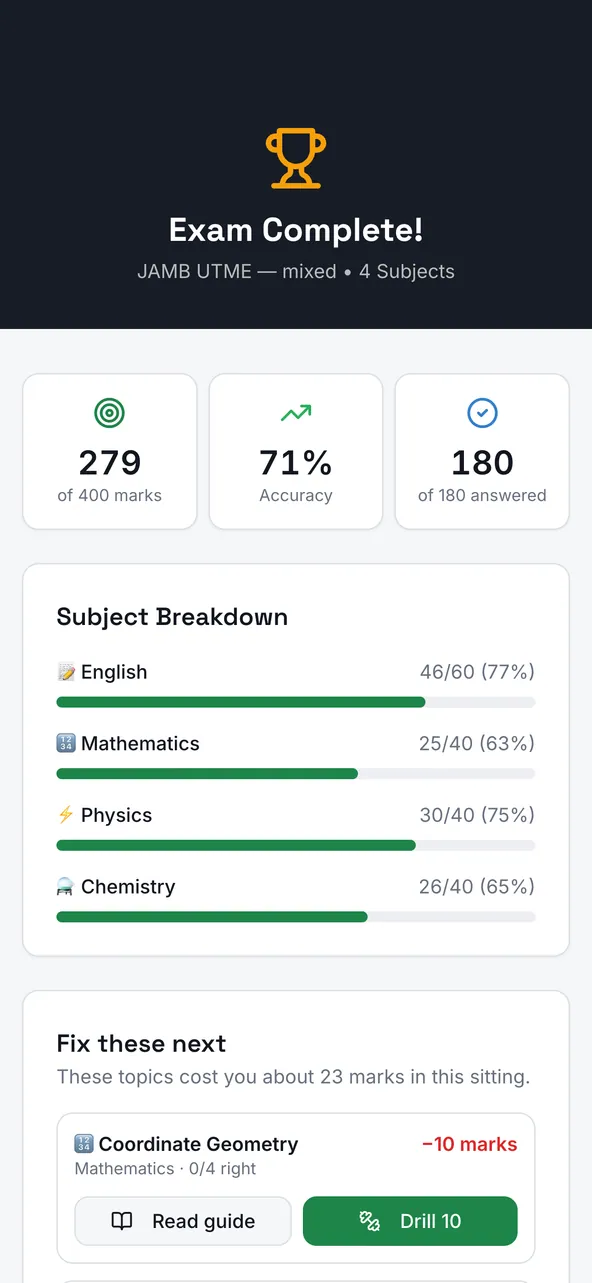
Etest CBT has a separate Post-UTME mode built from real university screening papers, so a Post-UTME question is never passed off as a JAMB one. Each question has the answer and an explanation.
Post-UTME tests usually cover your UTME subjects, so keep your JAMB practice going too. The app's JAMB UTME mode and timed full mock sit next to the Post-UTME mode.
The app also covers JAMB UTME, works offline and builds a study plan around your exam date. See the Etest CBT app page.
A simple Post-UTME practice plan
- 01
Read your school's notice.
Find out if your university sets a test or screens on documents, the date, and how it ranks candidates.
- 02
Check your aggregate.
Work out where your UTME score and O'level grades leave you, so you know how well you need to do in the test.
- 03
Practise past screening papers.
Answer Post-UTME questions in your UTME subjects under a clock and read every explanation you miss.
- 04
Keep general knowledge fresh.
Many tests add English and current affairs questions. Read the news and practise comprehension.
Post-UTME questions people ask
Does every university run a Post-UTME test?
No. Some set a test, often on computer, and others screen on your UTME score and O'level results only. Your university's screening notice says which.
What score do I need for Post-UTME?
At least your university's UTME cut-off, which is never below JAMB's minimum for universities. Competitive courses need more. See the JAMB cut off mark page for the current minimum.
Are these questions from my university?
They come from past university screening papers, but schools set their own tests. Use them to practise the subjects and the timing, and check your own school's format.
Does Etest CBT cover Post-UTME?
Yes. It has a separate Post-UTME mode with real screening questions and an explanation for every answer.
Is this official university material?
No. Etest CBT is an independent practice app. It is not linked to or endorsed by JAMB, WAEC, NECO or any university. For registration, dates, fees and results, use the official websites.
Sources
Exam rules change. Check dates, fees and results with the exam body. These are the sources for this page, last checked in November 2026.