
JAMB and exam prep
JAMB Mathematics past questions: the syllabus and how to practise
How to use JAMB Mathematics past questions: the five syllabus sections, worked practice examples, timing for 40 questions and the on screen calculator.
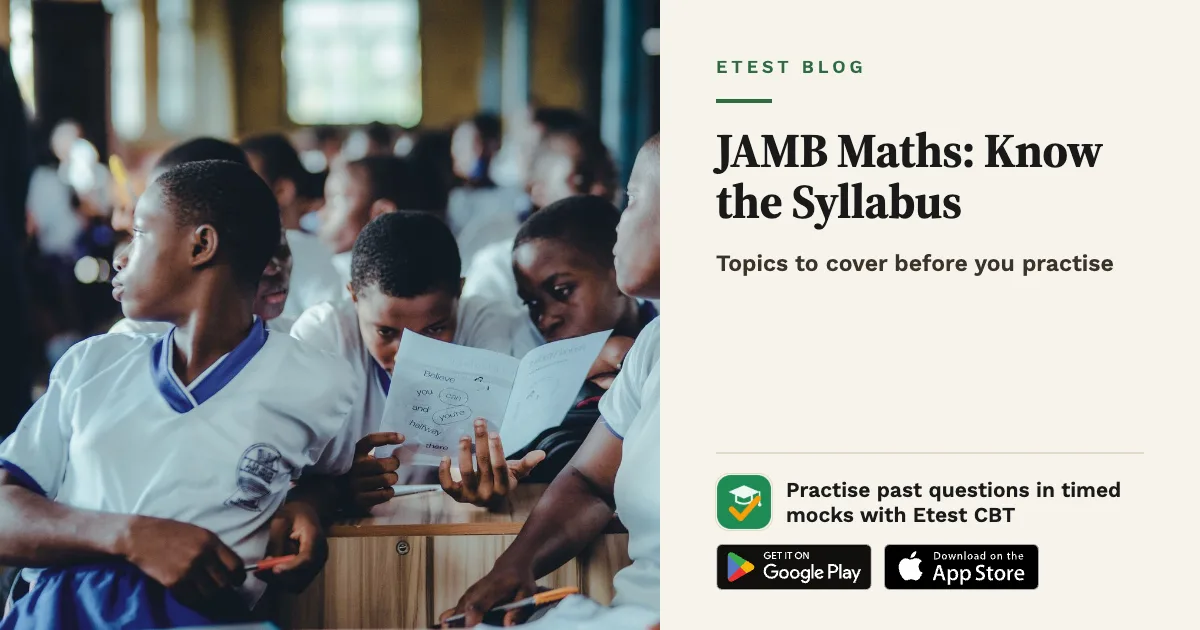
JAMB Mathematics past questions show you how JAMB asks about each topic in its official syllabus, from number bases to calculus. Work them topic by topic first, with an explanation for every mistake, then move to timed sets of 40, because Mathematics gets 40 of the 180 UTME questions and shares one two hour clock.
That's the short version. The longer version is below, and it starts with the thing most students skip: reading the syllabus itself.
Key points
- Mathematics is 40 questions in the UTME. The whole exam is 180 questions in two hours, according to JAMB's 2026 training manual.
- JAMB's Mathematics syllabus has five sections: Number and Numeration, Algebra, Geometry and Trigonometry, Calculus, and Statistics.
- Past questions show you the style. The syllabus tells you the scope. You need both.
- The worked examples on this page are my own practice questions, not real JAMB questions.
- Practise with the on screen calculator in mind, because there's no physical one allowed in the hall.
What topics are in the JAMB Mathematics syllabus?
JAMB splits UTME Mathematics into five sections, and every past question you'll ever see fits into one of them. I downloaded the current syllabus PDF from JAMB's IBASS portal on 12 November 2026, and this is what it lists.
Section I, Number and Numeration. Number bases and modular arithmetic; fractions, decimals, approximations and percentages (including simple interest, profit and loss, shares and VAT); indices, logarithms and surds; sets and Venn diagrams.
Section II, Algebra. Polynomials up to degree 3, including the factor and remainder theorems; variation; inequalities; progressions (AP and GP); binary operations; matrices and determinants, capped at 3 by 3, with inverses only for 2 by 2.
Section III, Geometry and Trigonometry. Euclidean geometry, mensuration, loci, coordinate geometry and trigonometry, including bearings, heights and distances.
Section IV, Calculus. Limits, differentiation of algebraic and simple trigonometric functions, rate of change, maxima and minima, integration and area under a curve.
Section V, Statistics. Representation of data, mean, median and mode, measures of dispersion, permutation and combination, and probability.
Notice the limits written into it. Venn diagrams with no more than three sets. Polynomials no higher than degree 3. Those caps matter, because they tell you where to stop. A student who spends a week on 4 by 4 determinants is studying for a different exam.
If you haven't turned the syllabus into a timetable yet, I walk through it in turning the JAMB syllabus into a weekly study plan.
How many Mathematics questions are in JAMB, and how long do you get?
You get 40 Mathematics questions, each with four options from A to D. JAMB's 2026 training manual describes the UTME as 180 questions in two hours: 60 in Use of English and 40 in each of your other three subjects. There's no separate Mathematics timer. The two hours cover all four papers.
Do the sums. 120 minutes across 180 questions is 40 seconds a question on average. Forty Mathematics questions at that pace is about 26 minutes and 40 seconds.
And that's the problem with Mathematics. A question on sets might take you 20 seconds. A question on the sum of a GP or the area under a curve can easily eat two minutes if you're rusty. So the average hides a real fight for time. Plenty of students plan to "do maths last" and then find 15 minutes left for 40 questions.
My take: do your Mathematics in the first hour, while your head is clear, and come back to the slow ones at the end. Flag what you skip. I break down the timing in more detail in JAMB CBT time management.
Scores, by the way, are reported out of 400 across all four subjects. When JAMB's Registrar named the 2026 top scorer on 11 May 2026, the score was 372 out of 400. I couldn't find a JAMB document that publishes how many marks a single question is worth, so ignore anyone who tells you an exact figure.
Which Mathematics topics should you practise first?
Start with the topics that are quick to learn and show up as short questions: number bases, indices and logarithms, sets, variation and simple probability. They give you marks for little time.
Then move to the heavier ones. Calculus, progressions, mensuration and trigonometry need more practice, and they're where speed comes from repetition rather than cleverness.
Here's how I'd order a first pass, roughly:
| Order | Topic group | Why |
|---|---|---|
| 1 | Number bases, indices, logarithms, surds | Short rules, quick marks |
| 2 | Sets, variation, inequalities | Few steps per question |
| 3 | Statistics and probability | Formula driven, easy to drill |
| 4 | Coordinate geometry, mensuration | Needs formulas memorised |
| 5 | Trigonometry, bearings | Diagrams take time |
| 6 | Calculus, matrices, progressions | Most steps, most practice |
That order isn't from JAMB. It's mine, built from how long each type of question takes to solve. If you're already strong in calculus, skip ahead. Your weak list beats my table.
Can you try some practice questions?
Yes. These three are my own practice examples, written for this page. They follow the syllabus topics, but they are not real JAMB past questions.
Practice example 1 (number bases). Convert 101101 in base 2 to base 10. A. 43 B. 45 C. 47 D. 53
Answer: B. Work from the right: 1 + 0 + 4 + 8 + 0 + 32 = 45. The trap is starting from the left and getting the place values backwards.
Practice example 2 (differentiation). If y = 3x² − 5x + 2, find dy/dx when x = 2. A. 5 B. 6 C. 7 D. 12
Answer: C. dy/dx = 6x − 5. At x = 2 that's 12 − 5 = 7. Option D is what you get if you forget to subtract the 5.
Practice example 3 (probability). A bag holds 3 red balls and 5 blue balls. Two are picked one after the other without replacement. What is the probability both are red? A. 9/64 B. 3/28 C. 3/8 D. 1/4
Answer: B. 3/8 for the first red, then 2/7 for the second, because one red is gone. 3/8 × 2/7 = 6/56 = 3/28. Option A is the "with replacement" answer, which is a very common wrong choice.
Notice something about all three. The wrong options aren't random. Each one is the answer to a specific mistake. That's worth knowing when you study real past questions too: when you pick a wrong option, ask which mistake produces it.
How do you use JAMB Mathematics past questions properly?
Work them in topic rounds first, then in timed papers. Reading the answers to hundreds of questions feels productive, but it mostly trains recognition, and Mathematics needs you to actually produce the working.
A routine that works:
- Pick one topic. Say, logarithms.
- Do 20 past questions on it, untimed. Write the working on paper, the way you will on the rough sheet in the hall.
- Mark them and read every explanation, including for the ones you got right by luck.
- Log the mistakes. Did you not know the rule, know it and slip, or know it and take too long? Those are three different problems with three different fixes.
- Repeat the topic a week later with fresh questions.
After you've been round most of the syllabus, switch to timed sets of 40. Then full mocks. I explain the error log in how to use JAMB past questions without wasting them, and it's the habit I'd start with if you only pick one.
One more thing. Questions do sometimes come back in a similar form, but don't bank on memorising answers. JAMB changes numbers and wording, and a memorised answer to a changed question is just a confident wrong answer.
What about the calculator in the JAMB CBT?
You can't bring a calculator. JAMB's training manual lists calculators among prohibited items and tells candidates to click the calculator icon on the screen instead. So practise with something similar. If you only ever use a scientific calculator at home, the on screen one will feel slow on exam day, and slow costs you in Mathematics more than anywhere else.
Better still, get good at mental shortcuts for the easy arithmetic and save the calculator for genuine number crunching.
Practise with Etest CBT
Etest CBT is my own app for this. Mathematics is one of its subjects, and it gives you:
- Past questions with an explanation for every answer, so each wrong option teaches you something
- Timed JAMB mock exams in the CBT format, including a full mock of 60, 40, 40 and 40 questions in two hours
- An on screen calculator and a Retry my mistakes option, so you drill the questions you got wrong
- Post-UTME, WAEC and NECO practice in the same app, and it works offline
Get it on Google Play or the App Store. It is independent of JAMB and cannot predict your score.
Frequently asked questions
How many Mathematics questions are in JAMB?
Forty. JAMB's 2026 training manual describes the UTME as 180 questions in two hours, with 60 in Use of English and 40 in each of the other three subjects. There's no separate time for Mathematics, so the two hours cover all four of your papers.
Is calculus in the JAMB Mathematics syllabus?
Yes. Section IV of JAMB's Mathematics syllabus is Calculus. It covers limits, differentiation of algebraic and simple trigonometric functions, rate of change, maxima and minima, integration and area under a curve. It's one of the slower sections, so start practising it early.
Do JAMB Mathematics questions repeat?
Similar questions do come back, often with changed numbers or wording. That's why memorising answers is risky. Learn the method behind each question so you can solve a new version, and use past questions to learn the style and the traps in the options.
How many years of JAMB Mathematics past questions should I study?
There's no official number. Understanding a few years properly, with every mistake logged and redone, is worth more than racing through many. Cover every syllabus section first, then use extra years for timed practice.
Can I use a calculator in JAMB Mathematics?
Not your own. JAMB's training manual lists calculators as prohibited items and points candidates to the calculator icon on the screen. Practise with a basic on screen calculator before the exam so it doesn't slow you down.
How I wrote this
On 12 November 2026 I downloaded JAMB's Mathematics syllabus PDF from the IBASS portal and took every topic on this page from it. The question count and timing come from JAMB's 2026 training manual, which I read in October 2026. The three worked examples are my own and are labelled that way. JAMB has not published a 2027 format, so check jamb.gov.ng before your exam.
Practice with Etest CBT
Timed JAMB practice with explanations and a study plan, free on the App Store and Google Play.

John Osakwe
John Osakwe has built 100+ apps and websites since 2015, including Etest CBT, FizzFree and Pawlarm. More about John.