
JAMB and exam prep
JAMB Chemistry past questions: the 18 syllabus topics to practise
JAMB Chemistry past questions mapped to the official syllabus: moles, organic chemistry, electrolysis and more, with labelled practice examples.
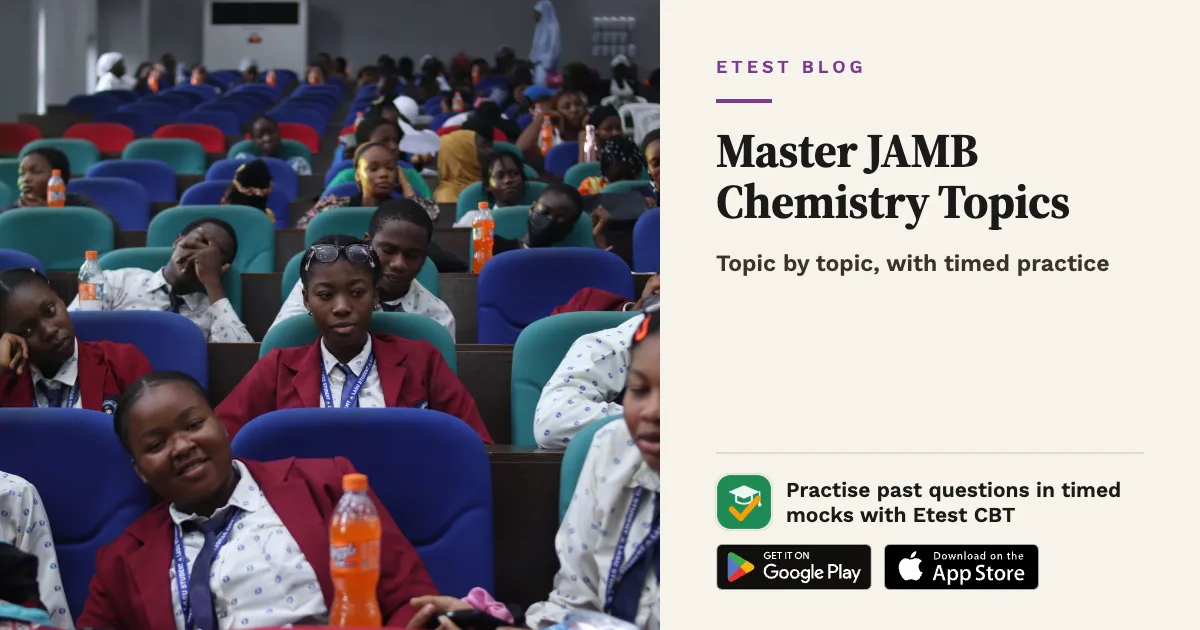
JAMB Chemistry past questions show you how JAMB tests the 18 topics in its official Chemistry syllabus, from separation of mixtures to organic compounds. Practise them topic by topic with an explanation for every mistake, then in timed sets of 40, because Chemistry gets 40 of the 180 UTME questions and shares one two hour clock with your other subjects.
Chemistry rewards two very different skills. Some questions are pure recall, like naming a gas or a process. Others are calculations with moles and charges. Past questions are the quickest way to see how JAMB mixes the two.
Key points
- Chemistry is 40 questions in the UTME, inside 180 questions in two hours, per JAMB's 2026 training manual.
- JAMB's Chemistry syllabus PDF lists 18 numbered topics. The last one is on the solar system and the earth's layers.
- Calculations (moles, electrolysis, pH, gas laws) and organic chemistry deserve the most practice time.
- The worked examples on this page are my own practice questions, not real JAMB questions.
- A PDF of answers can't time you or explain why. Use it for reading, not for practice.
What topics are in the JAMB Chemistry syllabus?
JAMB's Chemistry syllabus lists 18 numbered topics. I downloaded the current PDF from JAMB's IBASS portal on 12 November 2026, and here they are in its order:
- Separation of mixtures and purification of chemical substances
- Chemical combination (laws of combination, the mole concept)
- Kinetic theory of matter and gas laws
- Atomic structure and bonding
- Nuclear chemistry
- Solubility
- Environmental pollution
- Acids, bases and salts (including pH)
- Oxidation and reduction
- Electrolysis (including Faraday's laws)
- Energy changes
- Rates of chemical reaction
- Chemical equilibria
- Non-metals and their compounds
- Metals and their compounds
- Organic compounds
- Chemistry and industry (including biotechnology)
- Astronomical chemistry
That last one caught my eye. It covers the solar system, the planets, the earth's natural satellite and the composition of the earth: atmosphere, lithosphere and hydrosphere. It isn't something most Chemistry textbooks treat as chemistry, and I'd bet plenty of candidates skip it entirely. It's a short read. Do it.
Organic compounds, topic 16, is the giant. It runs from alkanes, alkenes and alkynes through benzene, alkanols, alkanals and alkanones, alkanoic acids, alkanoates, amines, carbohydrates, proteins and polymers. The syllabus keeps isomerism examples to no more than six carbon atoms, which is a useful limit to know when you're deciding how deep to go.
How many Chemistry questions are in JAMB, and how long do you get?
You answer 40 Chemistry questions, each with options A to D. JAMB's 2026 training manual describes the UTME as 180 questions in two hours: 60 in Use of English and 40 in each of your other three subjects. The two hours are shared, so there's no Chemistry timer of its own.
That works out to 40 seconds a question on average. Recall questions take far less. Mole and electrolysis calculations take more. So the skill isn't racing. It's knowing which questions to answer now and which to flag for later. I go through a two pass method in JAMB CBT time management.
Calculators aren't allowed in the hall. JAMB's manual points candidates to the calculator icon on the screen. Most JAMB Chemistry arithmetic is gentle, and with practice you'll do a lot of it in your head, which is faster anyway.
Which Chemistry topics should you practise first?
Start with the mole concept and chemical combination, because so much else depends on them. Electrolysis, gas laws, acids and bases, energy changes and equilibria all lean on being comfortable with moles and equations.
Then give organic chemistry real time. Searches tell the story here: the Keyword Planner data I pulled for Nigeria on 8 November 2026 showed "chemistry jamb question" up sharply over three months, and on X, tutors are openly selling manuals that promise "80+ in JAMB organic chemistry". Students clearly feel organic is where the marks hide. I think they're right, mostly because organic questions follow patterns. Once you can name compounds and recognise reactions from a general formula, a big group of questions becomes routine.
A rough order:
| Order | Topics | Why |
|---|---|---|
| 1 | Chemical combination, mole concept, gas laws | Everything else uses them |
| 2 | Atomic structure, bonding, periodic trends | Short, recall heavy |
| 3 | Acids, bases, salts, redox, electrolysis | Linked calculations |
| 4 | Organic compounds | Biggest topic, very pattern based |
| 5 | Energy changes, rates, equilibrium | Graphs and reasoning |
| 6 | Metals, non-metals, industry, pollution, astronomical chemistry | Mostly recall, good for last weeks |
It's my order, not JAMB's. Move your weakest topic earlier.
Can you try some practice questions?
Three to try. These are my own practice examples, written for this page. They follow the JAMB syllabus, but they are not real JAMB past questions.
Practice example 1 (mole concept). How many molecules are in 4.4 g of carbon(IV) oxide, CO₂? (C = 12, O = 16, Avogadro's constant = 6.02 × 10²³) A. 6.02 × 10²¹ B. 6.02 × 10²² C. 6.02 × 10²³ D. 2.65 × 10²⁴
Answer: B. The molar mass of CO₂ is 12 + 32 = 44 g/mol, so 4.4 g is 0.1 mol. Multiply by Avogadro's constant: 0.1 × 6.02 × 10²³ = 6.02 × 10²². Option D is what you get if you multiply 4.4 by Avogadro's constant and forget to divide by 44.
Practice example 2 (organic naming). What is the IUPAC name of CH₃CH₂CH₂OH? A. Propanal B. Propan-1-ol C. Propanoic acid D. Propan-2-ol
Answer: B. Three carbons gives "prop", the OH group makes it an alkanol, and it's on the end carbon, so it's propan-1-ol. Option D puts the OH on the middle carbon, which would be CH₃CH(OH)CH₃.
Practice example 3 (pH). What is the pH of a 0.01 mol/dm³ solution of hydrochloric acid? A. 1 B. 2 C. 7 D. 12
Answer: B. HCl is a strong acid and ionises completely, so the hydrogen ion concentration is 0.01, which is 10⁻² mol/dm³. pH is the negative log of that, which is 2. Option D is the pH of an alkali at the same concentration.
None of these needs a calculator if you know your powers of ten. Keep your powers of ten sharp and a lot of Chemistry arithmetic becomes mental.
How do you use JAMB Chemistry past questions properly?
Work them by topic, write out every calculation, and read the explanation for each one, including the ones you got right. Then move to timed sets of 40.
The method I'd use:
- Choose one topic, for example electrolysis.
- Do 20 past questions on it, untimed, with full working.
- Mark them and read every explanation.
- Write down why each mistake happened. Didn't know the fact? Knew it and slipped? Knew it but took too long?
- Redo that topic a week later with new questions.
I explain the mistake log in detail in how to use JAMB past questions without wasting them.
About the PDFs. "Chemistry JAMB past questions and answers PDF" is one of the bigger searches in this area, and I get why. A PDF is easy to share on WhatsApp. But it can't time you, it can't mark you, and most give you a letter with no reason behind it. In Chemistry the reason is everything, because the next question will use the same idea with different numbers.
If you're planning a Post-UTME too, many university screening tests cover the same Chemistry topics. My guide to Post UTME past questions explains how screening differs by school.
Practise with Etest CBT
Etest CBT is my own app for this. Chemistry is one of its subjects, and it gives you:
- Past questions with an explanation for every answer, so you see the reasoning, not just the letter
- Timed JAMB mock exams in the CBT format, including a full mock of 60, 40, 40 and 40 questions in two hours
- Study mode and study guides for learning a topic before you test yourself
- Post-UTME, WAEC and NECO practice in the same app, and it works offline
Get it on Google Play or the App Store. It is independent of JAMB and cannot predict your score.
Frequently asked questions
How many Chemistry questions are in JAMB?
Forty. JAMB's 2026 training manual describes the UTME as 180 questions in two hours: 60 in Use of English and 40 in each of your other three subjects. Chemistry has no separate timer, so it shares the two hours with your other papers.
What is the hardest part of JAMB Chemistry?
For most students it's calculations (moles, electrolysis, gas laws) and organic chemistry. Both improve fast with practice because the questions follow patterns. Learn the mole concept first, then naming and reactions of organic compounds, and drill both with explained answers.
Is organic chemistry in the JAMB syllabus?
Yes. Topic 16 of JAMB's Chemistry syllabus is organic compounds. It covers alkanes, alkenes, alkynes, benzene, alkanols, alkanoic acids, alkanoates, amines, carbohydrates, proteins and polymers, plus IUPAC naming. Isomerism examples stay within six carbon atoms.
What is astronomical chemistry in the JAMB syllabus?
It's topic 18 in JAMB's Chemistry syllabus. It covers the solar system, the planets, the earth's natural satellite and the composition of the earth: atmosphere, lithosphere and hydrosphere. It's short, so read it rather than skip it.
Are JAMB Chemistry past questions and answers in PDF enough?
They help for reading, but they can't time or mark you, and many give answers without reasons. Use them alongside practice that explains each answer and runs on a timer, so you learn the method and the pace together.
How I wrote this
On 12 November 2026 I downloaded JAMB's Chemistry syllabus PDF from the IBASS portal and took the 18 topics from it. The question count and timing come from JAMB's 2026 training manual. The search data comes from Google Keyword Planner for Nigeria and my own look at posts on X, both on 8 November 2026. The worked examples are mine and are labelled as practice. JAMB has not published a 2027 format, so check jamb.gov.ng before your exam.
Practice with Etest CBT
Timed JAMB practice with explanations and a study plan, free on the App Store and Google Play.

John Osakwe
John Osakwe has built 100+ apps and websites since 2015, including Etest CBT, FizzFree and Pawlarm. More about John.